For more than two decades, AMRRIC’s work alongside rural and remote Aboriginal and Torres Strait Islander communities has demonstrated the close connections between the health of companion animals, people and Country. It has also revealed an important gap: knowledge and experiences arising through community animal health programs have not always been reflected in the research evidence informing policy, practice and investment.
In 2022, AMRRIC established a dedicated One Health Research Coordinator role, made possible through philanthropic investment, to help bridge this gap.
Now, an evaluation of the initiative’s first four years demonstrates the value of dedicated research coordination in strengthening partnerships, generating evidence and creating opportunities for community priorities and practical experience to inform One Health research.
Four years of research collaboration and impact
Between March 2022 and June 2026, AMRRIC’s research coordination function supported:
-
66 One Health research collaborations, involving 197 research and sector partners across 68 organisations.
-
141 university students through research supervision, mentoring and professional development opportunities.
-
Approximately $5.8 million in collaborative One Health research investment, through successful funding applications supported by the role.
The initiative also strengthened AMRRIC’s organisational research governance, connected researchers with remote community animal health contexts, and helped translate research knowledge into policy and professional practice.
The dedicated coordination function is held by Dr Jessica Hoopes, whose work has helped build the relationships and research capability underpinning these achievements.
Connecting research with community priorities
A central objective was to ensure that research is relevant to the priorities and experiences of rural and remote Aboriginal and Torres Strait Islander communities.
The evaluation found that 79% of research activities aligned with identified community and stakeholder priorities, including those arising directly through community engagement and indirectly through AMRRIC’s long-term programs and partnerships.
One example demonstrates the importance of these connections – in 2025, concerns raised by an AMRRIC community-based veterinary partner about parasite resistance were connected with relevant expertise at the University of Sydney. This helped initiate research into canine hookworm resistance, with accessible information and consent resources supporting participation.
The example illustrates how dedicated coordination can help turn practical animal health concerns into research opportunities that might otherwise struggle to gain attention or access appropriate expertise.
Strengthening Indigenous participation and research capability
The evaluation also examined progress towards strengthening Aboriginal and Torres Strait Islander participation in One Health research.
Among original research projects progressing to implementation, 50% had Aboriginal and Torres Strait Islander representation on the research team.
These outcomes represent important progress, while the evaluation also identifies opportunities to strengthen how community priorities are systematically documented and how Indigenous researchers and community stakeholders participate in research development, decision-making and delivery.
Beyond individual projects, the initiative supported stronger research partnerships, governance processes and expectations around culturally appropriate engagement, community benefit and Indigenous participation.
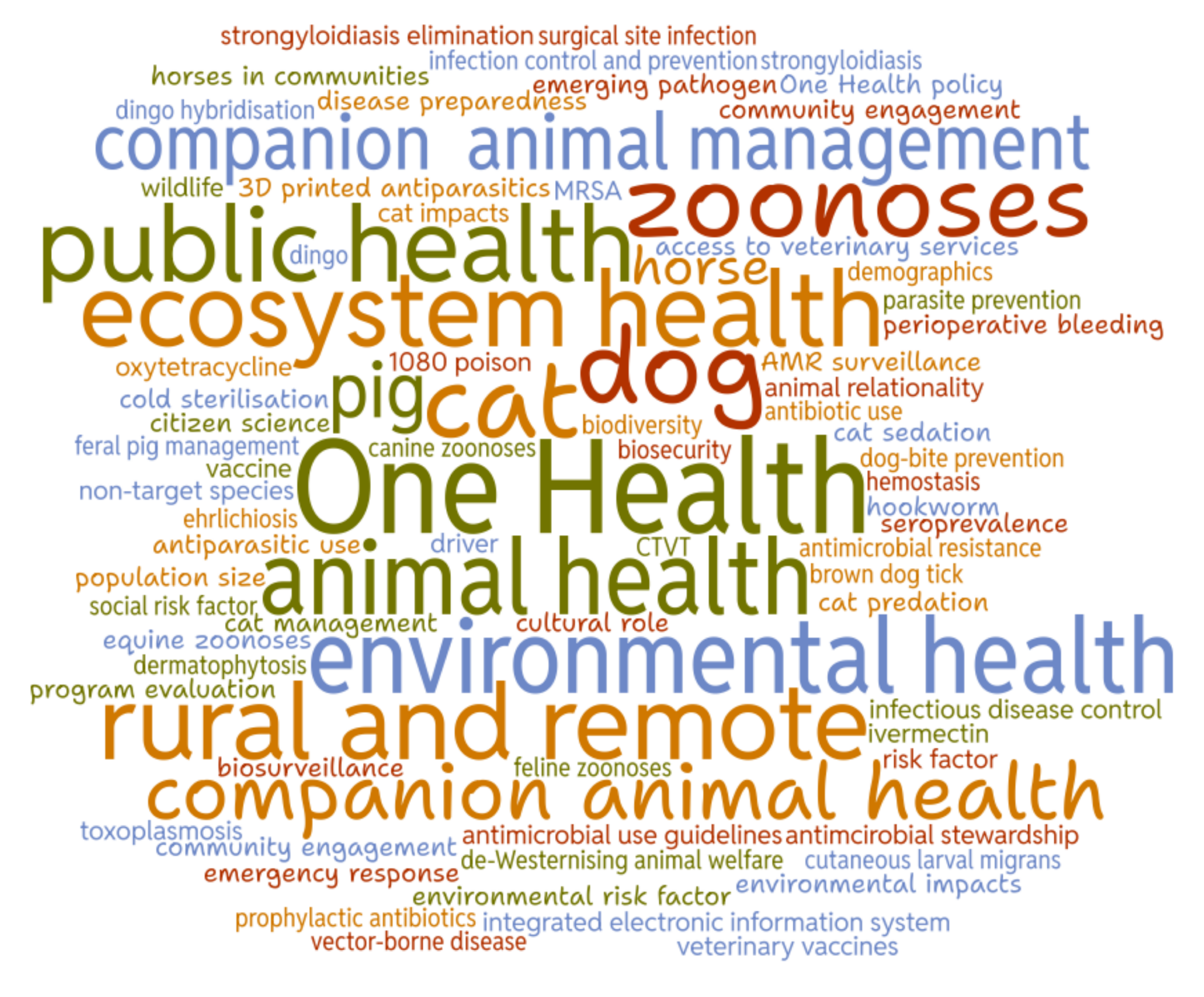
A representation of the breadth of topics investigated between 2022 and 2026 by AMRRIC’s One Health Research Coordination Initiative.
Sustaining the connections that make research possible
The evaluation highlights that effective research coordination is about much more than developing projects or producing publications.
It provides the dedicated capacity to connect questions with expertise, strengthen relationships, navigate research processes and keep community context and potential benefits central throughout research development.
The original philanthropic funding for this role concluded in June 2026. While the initiative has established valuable research networks and organisational capability, continued investment is needed to sustain and build on these achievements.
AMRRIC welcomes opportunities to work with research institutions, funding partners and other organisations committed to strengthening community-responsive One Health research in rural and remote Australia.
